

Are you curious about how to understand and compare the specifications of COB LED displays?
Knowing the key parameters of a COB LED display is essential when making a purchase, planning an installation, or evaluating the impact of an LED screen for your application. By understanding these specifications, you can accurately assess which display is best suited to your needs, whether you’re focused on image clarity, energy efficiency, or long-term durability.
In this post, I’ll guide you through the essential COB LED display specifications. These are the criteria that I check to judge a display’s performance, reliability, and overall value—so you’ll know exactly what to look for and how each parameter affects the end result.
Table of Contents
1: Introduction to COB LED Display Technology
COB (Chip-on-Board) LED display technology represents a significant advancement in digital display solutions. Unlike traditional SMD technologies where each LED is individually packaged, COB integrates multiple LED chips directly onto a board, resulting in a seamless, robust, and uniform light-emitting surface.
Compared to conventional SMD LEDs, COB displays offer notable advantages in protection against dust, moisture, and impact.
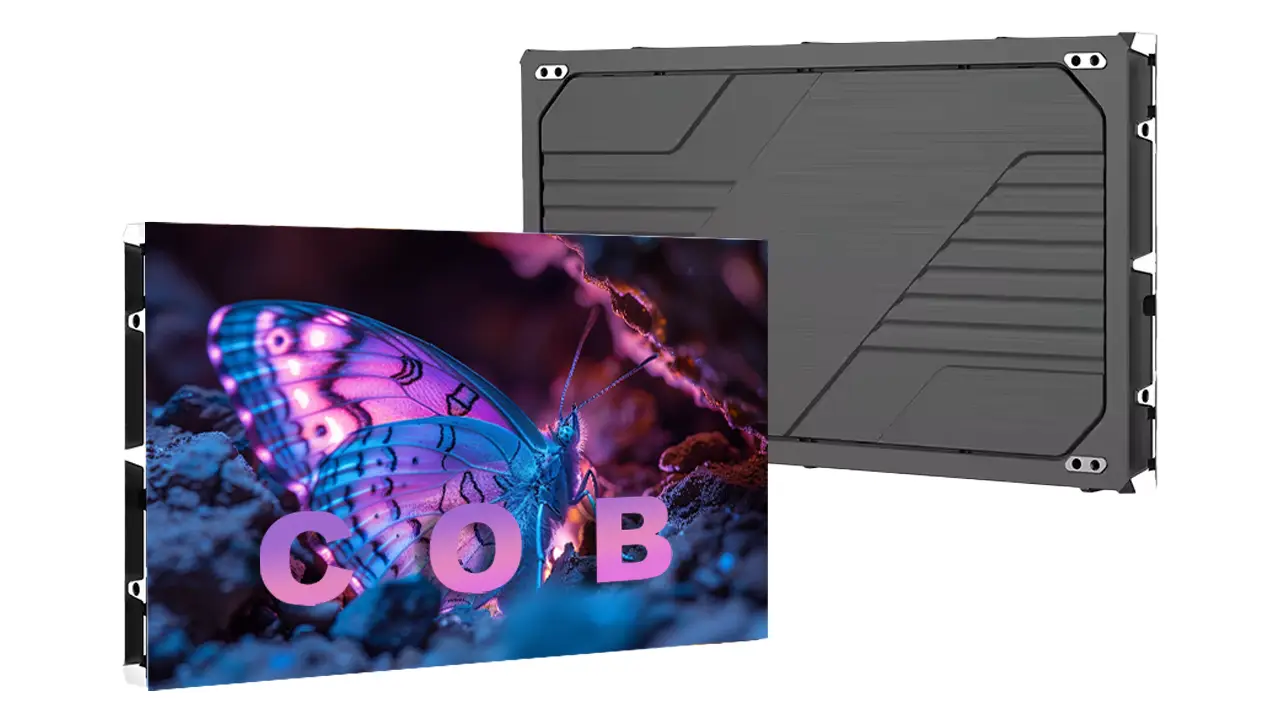
As we all know, conventional SMD LED displays have their own set of specifications. You might wonder, what about COB LED displays—are their specifications the same as traditional SMD LEDs, or do they differ in meaningful ways?
Now, in the next section, I’ll list the main specifications one by one.
2: LED Encapsulation
The first and perhaps most fundamental specification of any COB (Chip-on-Board) LED display is its LED encapsulation process.
Generally, there si two common packaging technologies: Flip Chip and Face-Up.
Face-Up COB
In the face-up COB process, the chips are attached with their light-emitting side facing outward.
In face-up COB, thin gold (or copper) wires connect the chip’s electrodes to pads on the PCB. This step introduces reliability risks (wire breakage, poor contact, or corrosion), limits how close chips can be placed, and can reduce light output by blocking some of the emission area.
Because of these issues, the face-up Encapsulation is now replaced by Flip Chip COB.
Flip Chip COB
In the Flip Chip approach, the LED chips are mounted “face-down” on the PCB.
This means the light-emitting surface faces the circuit board, and electrical connections are made directly through the bottom of the chip, rather than wire bonds from the top.
The Flip Chip structure drastically improves heat dissipation because the thermal path from the chip to the PCB is shorter and more direct, reducing the risk of thermal damage and maintaining stable performance even at high brightness levels. This efficient heat management is one of the main reasons Flip Chip COB LEDs boast a longer service life and better reliability compared to older packaging methods.
- Better Protection: The absence of exposed wires and less susceptibility to mechanical stress make Flip Chip COB LEDs more robust.
- Superior Thermal Management: Heat dissipates directly to the substrate, which preserves LED efficiency and minimizes color drift over time.
- Higher Consistency: Flip Chip COB technology allows for ultra-fine pixel pitch, essential to high-resolution displays.
Currently, flip chip packaging is the mainstream technology in COB Display.
3: Pixel Pitch
Pixel pitch is a core specification for both conventional SMD and modern COB LED displays. It refers to the distance, measured in millimeters, between the centers of two adjacent LED pixels.
This parameter directly determines the screen’s resolution and optimal viewing distance: the smaller the pixel pitch, the finer the image detail and the closer viewers can comfortably stand to the screen without perceiving pixelation.
While the definition of pixel pitch is fundamentally the same for SMD and COB technologies, COB LED displays stand out because they excel in the ultra-small pixel pitch segment.
Here are the common Pixel Pitch Options for COB LED Displays:
- 0.6mm
- 0.78mm
- 0.9375mm
- 1.25mm
- 1.5625mm
- 1.875mm
4: Pixel Density (dots/m²)
Pixel Density refers to the number of LED dots (pixels) within a square meter of an LED display. As the same to SMD LED display, it is a critical parameter as it directly impacts the resolution and clarity of the display. The calculation is as follows:
Pixel Density = 1,000,000 / (Pixel Pitch * Pixel Pitch)
Below is a table illustrating Pixel Pitch and its corresponding Pixel Density values for COB LED displays:
| Pixel Pitch (mm) | Pixel Density (dots/m²) | Notes |
|---|---|---|
| 0.6 | 2,560,000 | Extremely fine pitch for ultra-HD displays and close viewing. |
| 0.78 | 1,638,400 | Ideal for detailed indoor applications like control rooms. |
| 0.9375 | 1,137,778 | Provides excellent resolution with versatility in usage. |
| 1.25 | 640,000 | Balanced choice for semi-professional indoor installations. |
| 1.5625 | 409,600 | Commonly used for moderate-distance viewing. |
| 1.875 | 284,444 | Suitable for long-distance large-scale outdoor displays. |
5: Size
Size specification for COB LED displays encompasses module size, cabinet size, and full-panel dimension, most commonly expressed as length × width × height (mm).
These physical aspects directly affect installation versatility, transport logistics, and visual integration into diverse spaces.
Module Size
Module size—serves as the fundamental building block. Smaller modules allow for precise, custom configurations, adapting the display surface to architectural needs.
Currently, the common module size is 150×168.75mm or 300×168.75mm. Some customized COB LED displays might have a 250×250mm size.

| Size | Pixel Pitch |
| 300 mm x 168.75 mm | P1.85, P1.5625, P1.25, P0.9375, P0.78, P0.625 |
| 150 mm x 168.75 mm | P1.85, P1.5625, P1.25, P0.9375, P0.78, P0.625 |
Cabinet Size
Cabinet size impacts efficient assembly and shipping, reducing installation time and minimizing structural and mounting complexity.
Common cabinet for COB LED screen includes:

| Size | Pixel Pitch |
| 600 mm x 337.5 mm | P1.85, P1.5625, P1.25, P0.9375, P0.78, P0.625 |
| 500 mm x 500 mm | P1.85, P1.5625, P1.25 |
For more information about the COB LED Screen size, check here.
6: Resolution
Resolution in COB LED displays refers to the total number of pixels on the screen, influencing the sharpness and clarity of the image. It is directly tied to the pixel pitch and physical size of the module or cabinet:
- A smaller pixel pitch yields higher pixel density and resolution within the same area.
- Resolution is measured as the number of pixels horizontally multiplied by the number of pixels vertically (e.g., 1920 × 1080).
COB LED and SMD displays calculate resolution similarly. However, COB technology achieves higher pixel densities and finer resolutions due to its smaller achievable pixel pitch, which is ideal for ultra-HD displays.
Module Resolution
The table below illustrates the Module Resolution, based on common Pixel Pitches and two standard Module Sizes: 150×168.75mm and 300×168.75mm:
| Pixel Pitch (mm) | Module Size (150×168.75mm) | Module Size (300×168.75mm) |
|---|---|---|
| 0.6 | 250 × 281 | 500 × 281 |
| 0.78 | 192 × 217 | 385 × 217 |
| 0.9375 | 160 × 180 | 320 × 180 |
| 1.25 | 120 × 135 | 240 × 135 |
| 1.5625 | 96 × 108 | 192 × 108 |
| 1.875 | 80 × 90 | 160 × 90 |
Cabinet Resolution
The table below shows the Cabinet Resolution, based on Pixel Pitches and a standard Cabinet Size of 600×337.5mm:

| Pixel Pitch (mm) | Cabinet Resolution (600×337.5mm) |
|---|---|
| 0.6 | 1000 × 562 |
| 0.78 | 769 × 433 |
| 0.9375 | 640 × 360 |
| 1.25 | 480 × 270 |
| 1.5625 | 384 × 216 |
| 1.875 | 320 × 180 |
7: Refresh Rate
The Refresh Rate refers to the number of times a COB LED display updates its image per second, measured in Hertz (Hz). A higher refresh rate ensures smoother and more stable images, especially noticeable in dynamic content and fast-moving visuals.
Both COB and SMD displays share the concept of refresh rate measurement. However, COB LED displays excel in consistently
Here is the common refresh rate for COB LED display:
- 3840Hz Refresh Rate: Commonly used in professional settings like broadcasting, virtual studios, and sports viewing due to its ability to handle dynamic, fast-moving content.
- 7680Hz Refresh Rate: Ultra-high-end technology, ensuring image stability even in critical high-speed applications.
8: Brightness
Brightness, measured in candela per square meter (cd/m²) or nits, refers to the intensity of light emitted by an COB LED display. This parameter is essential in choosing the appropriate display for various environments:
- Higher brightness counters ambient light for outdoor displays.
- Lower, adjustable brightness is suitable for indoor environments to avoid eye strain and glare.
Both COB and SMD LED displays share similar approaches to brightness measurement. However, COB displays excel in maintaining uniformity and achieving tailored brightness levels suitable for indoor applications.
| Application | Brightness (cd/m²) | Pixel Pitch |
| Indoor COB | 500 – 800 cd/m² | P1.85, P1.5625, P1.25, P0.9375, P0.78, P0.625 |
| Half Outdoor COB | 2000 – 3000 cd/m² | P1.25, P0.9375, P0.78, P0.625 |
9: Contrast Ratio
The Contrast Ratio is the ratio between the brightest white and the darkest black that a display can produce. It is expressed as a number, e.g., 10,000:1. A higher contrast ratio enhances the depth and richness of images, improving the quality of visuals significantly.
COB LED displays generally achieve higher contrast ratios compared to traditional SMD displays due to their tighter encapsulation and absence of external lenses, which reduces light interference.
Contrast Ratio Table for COB LED Displays
| COB LED Display | Contrast Ratio | Notes |
| Standard COB | ≥10,000:1 | Perfect for professional and HDR content. |
| High-End COB | ≥12,000:1 | Exceptional clarity in low ambient light. |
| Advanced HDR COB Displays | ≥15,000:1 | Ideal for studios and broadcasting. |
12: Other Parameters
Apart from the parameters discussed earlier, COB LED displays have several additional parameters that influence the overall performance and application suitability. Here’s a breakdown of these parameters for different pixel pitches in a tabular format:
P0.6
| Category | Parameter | Specification | Notes |
| Basic Specs | Pixel Pitch | 0.625mm | Center-to-center LED spacing |
| Pixel Density | 2560000 dots/m² | ||
| Module Size | 150mm (W) × 168.75mm (H) | ||
| Cabinet Size | 600mm (W) × 337.5mm (H) × 39mm (D) | Ultra-thin die-cast aluminum | |
| Weight (Cabinet) | 5.3kg | ||
| Optical | Brightness | 500–800 cd/m² (adjustable) | Indoor optimized |
| Refresh Rate | ≥2,880Hz | Flicker-free video | |
| Grayscale | 14-bit (16,384 levels) | ||
| Contrast Ratio | ≥10,000:1 | HDR-ready | |
| Viewing Angle | 170° (H) / 170° (V) | COB wide-angle advantage | |
| Color Uniformity | ΔCx,y ≤ ±0.003 | Professional color accuracy | |
| Electrical | Power Consumption (Peak) | ≤450W/m² | |
| Power Consumption (Avg) | ≤150W/m² | Common cathode design | |
| Input Voltage | AC 110–220V | Global compatibility | |
| Driver IC | Constant current | ||
| Mechanical | Cabinet Material | Die-cast aluminum | CNC precision machining |
| Protection Level | IP34 (cabinet) / IP65 (module face) | Dust/splash resistant | |
| Maintenance | Front serviceable | No rear access needed | |
| Connection Method | Screw fixing + floating connector | Seamless | |
| Environmental | Operating Temperature | –20°C to +50°C | |
| Storage Temperature | –40°C to +70°C | ||
| Humidity | 10%–95% RH (non-condensing) | ||
| Advanced Features | Pixel Technology | Flip Chip COB (1R1G1B) | No wire bonding |
| Signal Interface | RJ45 | ||
| Correction | Single-point brightness/color calibration | Uniformity control | |
| Frame Rate | 50/60Hz | ||
| Lifespan (L70) | ≥100,000 hours | 70% brightness retention |
P0.78
| Category | Parameter | Specification | Notes |
| Basic Specs | Pixel Pitch | 0.78mm | Center-to-center LED spacing |
| Pixel Density | 1638400 dots/m² | ||
| Module Size | 150mm (W) × 168.75mm (H) | ||
| Cabinet Size | 600mm (W) × 337.5mm (H) × 39mm (D) | Ultra-thin die-cast aluminum | |
| Weight (Cabinet) | 5.3kg | ||
| Optical | Brightness | 500–800 cd/m² (adjustable) | Indoor optimized |
| Refresh Rate | ≥2,880Hz | Flicker-free video | |
| Grayscale | 14-bit (16,384 levels) | ||
| Contrast Ratio | ≥10,000:1 | HDR-ready | |
| Viewing Angle | 170° (H) / 170° (V) | COB wide-angle advantage | |
| Color Uniformity | ΔCx,y ≤ ±0.003 | Professional color accuracy | |
| Electrical | Power Consumption (Peak) | ≤450W/m² | |
| Power Consumption (Avg) | ≤150W/m² | Common cathode design | |
| Input Voltage | AC 110–220V | Global compatibility | |
| Driver IC | Constant current | ||
| Mechanical | Cabinet Material | Die-cast aluminum | CNC precision machining |
| Protection Level | IP34 (cabinet) / IP65 (module face) | Dust/splash resistant | |
| Maintenance | Front serviceable | No rear access needed | |
| Connection Method | Screw fixing + floating connector | Seamless | |
| Environmental | Operating Temperature | –20°C to +50°C | |
| Storage Temperature | –40°C to +70°C | ||
| Humidity | 10%–95% RH (non-condensing) | ||
| Advanced Features | Pixel Technology | Flip Chip COB (1R1G1B) | No wire bonding |
| Signal Interface | RJ45 | ||
| Correction | Single-point brightness/color calibration | Uniformity control | |
| Frame Rate | 50/60Hz | ||
| Lifespan (L70) | ≥100,000 hours | 70% brightness retention |
P0.9
| Category | Parameter | Specification | Notes |
| Basic Specs | Pixel Pitch | 0.9375mm | Center-to-center LED spacing |
| Pixel Density | 1,137,778 dots/m² | 1M/(pitch²) | |
| Module Size | 150mm (W) × 168.75mm (H) | ||
| Cabinet Size | 600mm (W) × 337.5mm (H) × 39mm (D) | Ultra-thin die-cast aluminum | |
| Weight (Cabinet) | 5.3kg | ||
| Optical | Brightness | 500–800 cd/m² (adjustable) | Indoor optimized |
| Refresh Rate | ≥2,880Hz | Flicker-free video | |
| Grayscale | 14-bit (16,384 levels) | ||
| Contrast Ratio | ≥10,000:1 | HDR-ready | |
| Viewing Angle | 170° (H) / 170° (V) | COB wide-angle advantage | |
| Color Uniformity | ΔCx,y ≤ ±0.003 | Professional color accuracy | |
| Electrical | Power Consumption (Peak) | ≤450W/m² | |
| Power Consumption (Avg) | ≤150W/m² | Common cathode design | |
| Input Voltage | AC 110–220V | Global compatibility | |
| Driver IC | Constant current | ||
| Mechanical | Cabinet Material | Die-cast aluminum | CNC precision machining |
| Protection Level | IP34 (cabinet) / IP65 (module face) | Dust/splash resistant | |
| Maintenance | Front serviceable | No rear access needed | |
| Connection Method | Screw fixing + floating connector | Seamless | |
| Environmental | Operating Temperature | –20°C to +50°C | |
| Storage Temperature | –40°C to +70°C | ||
| Humidity | 10%–95% RH (non-condensing) | ||
| Advanced Features | Pixel Technology | Flip Chip COB (1R1G1B) | No wire bonding |
| Signal Interface | RJ45 | ||
| Correction | Single-point brightness/color calibration | Uniformity control | |
| Frame Rate | 50/60Hz | ||
| Lifespan (L70) | ≥100,000 hours | 70% brightness retention |
P1.25
| Category | Parameter | Specification | Notes |
| Basic Specs | Pixel Pitch | 1.25mm | Center-to-center LED spacing |
| Pixel Density | 640,000 dots/m² | ||
| Module Size | 150mm (W) × 168.75mm (H) | ||
| Cabinet Size | 600mm (W) × 337.5mm (H) × 39mm (D) | Ultra-thin die-cast aluminum | |
| Weight (Cabinet) | 5.3kg | ||
| Optical | Brightness | 500–800 cd/m² (adjustable) | Indoor optimized |
| Refresh Rate | ≥2,880Hz | Flicker-free video | |
| Grayscale | 14-bit (16,384 levels) | ||
| Contrast Ratio | ≥10,000:1 | HDR-ready | |
| Viewing Angle | 170° (H) / 170° (V) | COB wide-angle advantage | |
| Color Uniformity | ΔCx,y ≤ ±0.003 | Professional color accuracy | |
| Electrical | Power Consumption (Peak) | ≤450W/m² | |
| Power Consumption (Avg) | ≤150W/m² | Common cathode design | |
| Input Voltage | AC 110–220V | Global compatibility | |
| Driver IC | Constant current | ||
| Mechanical | Cabinet Material | Die-cast aluminum | CNC precision machining |
| Protection Level | IP34 (cabinet) / IP65 (module face) | Dust/splash resistant | |
| Maintenance | Front serviceable | No rear access needed | |
| Connection Method | Screw fixing + floating connector | Seamless | |
| Environmental | Operating Temperature | –20°C to +50°C | |
| Storage Temperature | –40°C to +70°C | ||
| Humidity | 10%–95% RH (non-condensing) | ||
| Advanced Features | Pixel Technology | Flip Chip COB (1R1G1B) | No wire bonding |
| Signal Interface | RJ45 | ||
| Correction | Single-point brightness/color calibration | Uniformity control | |
| Frame Rate | 50/60Hz | ||
| Lifespan (L70) | ≥100,000 hours | 70% brightness retention |
P1.5625
| Category | Parameter | Specification | Notes |
| Basic Specs | Pixel Pitch | 1.5625mm | Center-to-center LED spacing |
| Pixel Density | 409,600 dots/m² | ||
| Module Size | 150mm (W) × 168.75mm (H) | ||
| Cabinet Size | 600mm (W) × 337.5mm (H) × 39mm (D) | Ultra-thin die-cast aluminum | |
| Weight (Cabinet) | 5.3kg | ||
| Optical | Brightness | 500–800 cd/m² (adjustable) | Indoor optimized |
| Refresh Rate | ≥2,880Hz | Flicker-free video | |
| Grayscale | 14-bit (16,384 levels) | ||
| Contrast Ratio | ≥10,000:1 | HDR-ready | |
| Viewing Angle | 170° (H) / 170° (V) | COB wide-angle advantage | |
| Color Uniformity | ΔCx,y ≤ ±0.003 | Professional color accuracy | |
| Electrical | Power Consumption (Peak) | ≤450W/m² | |
| Power Consumption (Avg) | ≤150W/m² | Common cathode design | |
| Input Voltage | AC 110–220V | Global compatibility | |
| Driver IC | Constant current | ||
| Mechanical | Cabinet Material | Die-cast aluminum | CNC precision machining |
| Protection Level | IP34 (cabinet) / IP65 (module face) | Dust/splash resistant | |
| Maintenance | Front serviceable | No rear access needed | |
| Connection Method | Screw fixing + floating connector | Seamless | |
| Environmental | Operating Temperature | –20°C to +50°C | |
| Storage Temperature | –40°C to +70°C | ||
| Humidity | 10%–95% RH (non-condensing) | ||
| Advanced Features | Pixel Technology | Flip Chip COB (1R1G1B) | No wire bonding |
| Signal Interface | RJ45 | ||
| Correction | Single-point brightness/color calibration | Uniformity control | |
| Frame Rate | 50/60Hz | ||
| Lifespan (L70) | ≥100,000 hours | 70% brightness retention |
P1.875
| Category | Parameter | Specification | Notes |
| Basic Specs | Pixel Pitch | 1.875mm | Center-to-center LED spacing |
| Pixel Density | 284444 dots/m² | ||
| Module Size | 150mm (W) × 168.75mm (H) | ||
| Cabinet Size | 600mm (W) × 337.5mm (H) × 39mm (D) | Ultra-thin die-cast aluminum | |
| Weight (Cabinet) | 5.3kg | ||
| Optical | Brightness | 500–800 cd/m² (adjustable) | Indoor optimized |
| Refresh Rate | ≥2,880Hz | Flicker-free video | |
| Grayscale | 14-bit (16,384 levels) | ||
| Contrast Ratio | ≥10,000:1 | HDR-ready | |
| Viewing Angle | 170° (H) / 170° (V) | COB wide-angle advantage | |
| Color Uniformity | ΔCx,y ≤ ±0.003 | Professional color accuracy | |
| Electrical | Power Consumption (Peak) | ≤450W/m² | |
| Power Consumption (Avg) | ≤150W/m² | Common cathode design | |
| Input Voltage | AC 110–220V | Global compatibility | |
| Driver IC | Constant current | ||
| Mechanical | Cabinet Material | Die-cast aluminum | CNC precision machining |
| Protection Level | IP34 (cabinet) / IP65 (module face) | Dust/splash resistant | |
| Maintenance | Front serviceable | No rear access needed | |
| Connection Method | Screw fixing + floating connector | Seamless | |
| Environmental | Operating Temperature | –20°C to +50°C | |
| Storage Temperature | –40°C to +70°C | ||
| Humidity | 10%–95% RH (non-condensing) | ||
| Advanced Features | Pixel Technology | Flip Chip COB (1R1G1B) | No wire bonding |
| Signal Interface | RJ45 | ||
| Correction | Single-point brightness/color calibration | Uniformity control | |
| Frame Rate | 50/60Hz | ||
| Lifespan (L70) | ≥100,000 hours | 70% brightness retention |
12: Download
13: Conclusion
In this post, we have explored the key parameters of COB LED displays, including Pixel Pitch, Pixel Density, Resolution, Refresh Rate, Brightness, Contrast Ratio, and other additional specifications like viewing distance, grayscale levels, power consumption, display lifetime, and weight. T
These features demonstrate the unparalleled performance and versatility of COB technology, especially in delivering ultra-fine resolutions, higher brightness uniformity, and durability compared to traditional SMD LEDs.
If you are considering COB LED displays for your project or need expert advice on selecting the right parameters for your application, feel free to contact us. Our team is here to guide you in finding the perfect solution for your needs. Let us help you bring your vision to life!


